“The ‘Organic Right’ is both ‘revolutionary’ and ‘conservative’ in-so-far as it advocates the literal meaning of a ‘revolution’, the return of a cycle, with an axis in the center; the axis being man’s connection with the Divine, whether one wants to accept it in a literal or in a symbolic sense.
“The Reactionary, or the ‘Rightist’, is the anti-Capitalist par excellence, because he is above and beyond the outlook form which both Capitalism and Marxism emerged in 19th century England, and he rejects in total this economic outlook on which both are found. As Knupffer, Spengler and others pointed out, both are materialistic. Thus the word ‘Reactionary’, usually used in a derogatory sense, can be accepted as an accurate term for what is required for a ‘Counter-Revolution’ against Capitalism, and its twin Marxism.”
—Kerry Bolton, The Banking Swindle (148–149)
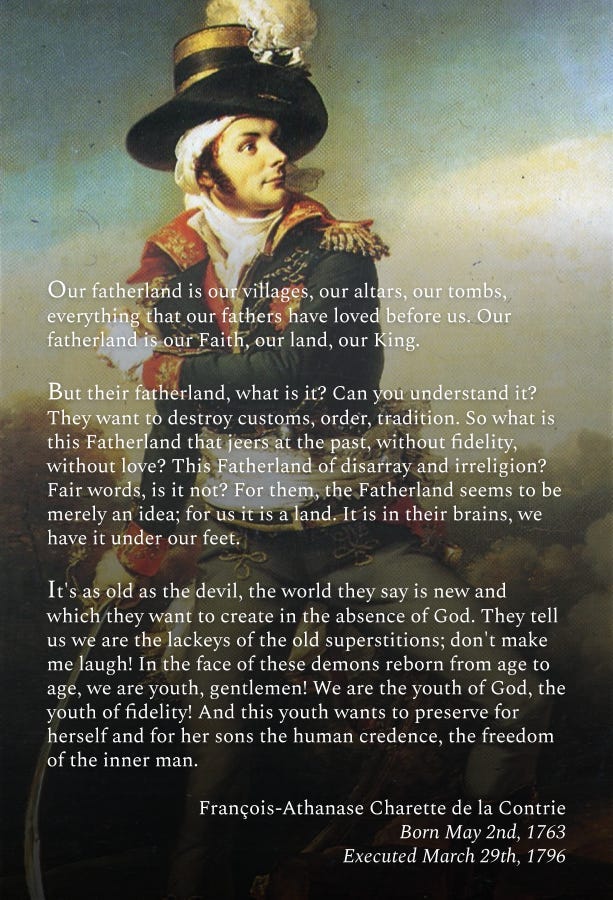
I imagine that if you took a general survey of American conservatives, the vast majority would agree with both the de la Contrie and the Paine quotations above—the former a Frenchman fighting against the Jacobin French Revolution, and the latter an integral Founding Father of America, who preached fervently about breaking away from the British Crown. The problem, though, is that the speakers are diametrically opposed: where de la Contrie speaks with Traditionalist/Christian priors, Paine does so with Enlightenment/Deist ones.
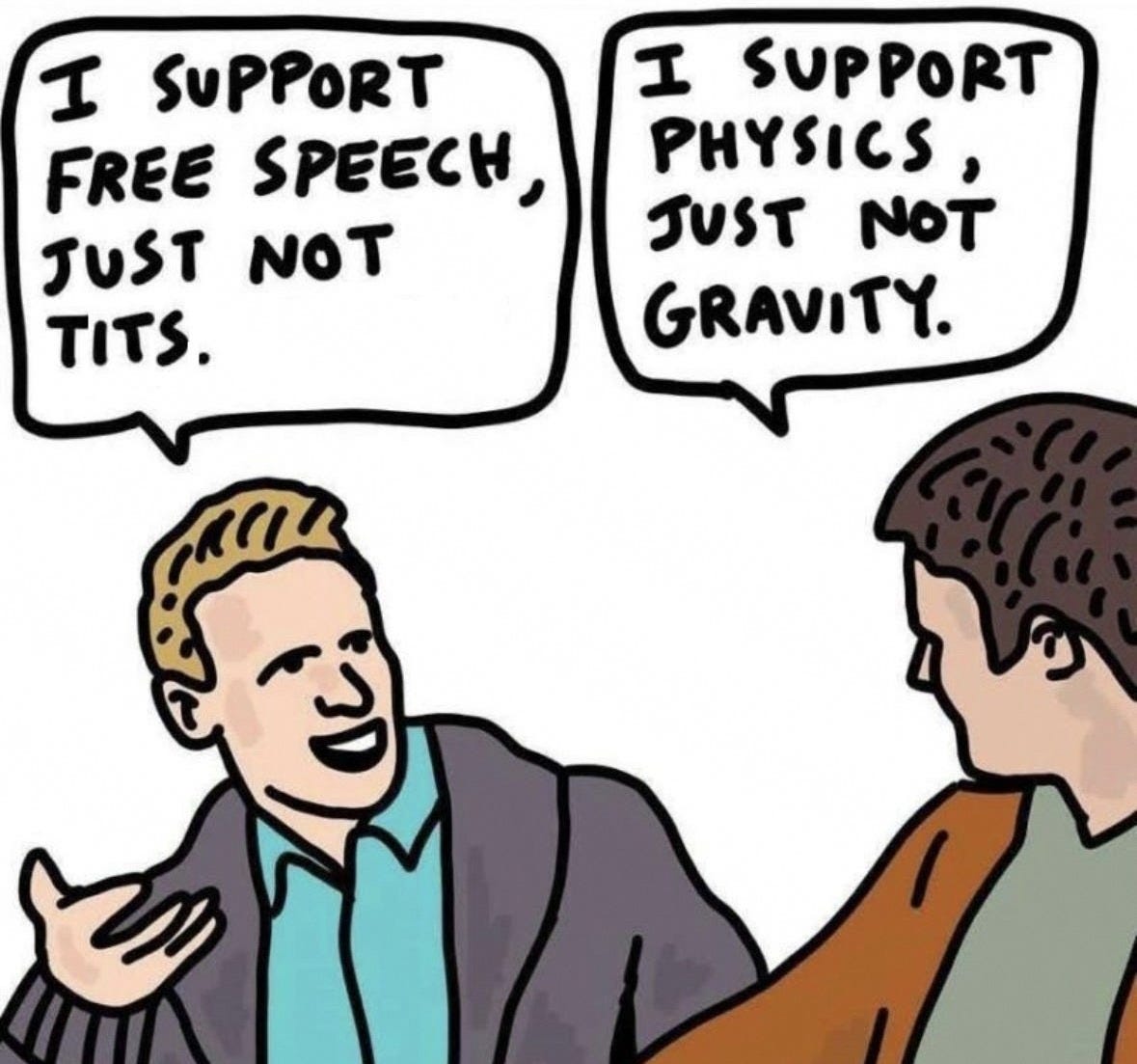
“The Right” is hard to define or pinpoint nowadays, largely because today’s conservative lives in a world of doublethink. The conservative loves his Bible and whatever brand of Christianity soothes his palate; but he will always fall back on the Constitution and Bill of Rights when faced with a social ill or government corruption. The conservative condemns the leftist for his insane promotion of gay rights or his defense of sex change operations for children; but he also fully supports free speech. Even when he feels the walls of self-contradiction closing in, today’s conservative resorts to the same ideas that got him there in the first place. Reevaluation seems impossible for him.
American conservatives must wake up and realize they are liberals, not conservatives, in the classical sense of those words. Over the decades, and particularly post-WW2, we have been programmed to misunderstand what both terms mean. To fix this problem, we should look at how both conservative and liberal presuppositions (assumptions) have been classically understood.
Michael Oakeshott, a British historian and political theorist, defined conservatism like this:
“To be conservative... is to prefer the familiar to the unknown, to prefer the tried to the untried, fact to mystery, the actual to the possible, the limited to the unbounded, the near to the distant, the sufficient to the superabundant, the convenient to the perfect, present laughter to utopian bliss”.
If we accept Oakeshott’s statement, actual Conservatism is a way of behavior and a way of life, not an ideology or a set of concepts to be followed; it is much greater and more integral than a merely political view. Today’s conservative, though, restricts the scope of the “familiar,” “limited,” and “tried” to the Constitution and Bill of Rights, which alone he reverences as religiously sacred. He fails to comprehend that a Constitution is, in reality, a mere piece of paper meant to reflect a certain and discrete people with shared culture and traditions which go beyond it. In his view, a piece of paper defines what an American is. (This idea has become known pejoratively as Magic Dirt Theory.)
This overly narrow scope of American Conservatism, its reverencing of the Constitution as a sacred, identity-changing thing, reveals that American Conservatism is actually has a secular religion as the basis of its worldview. As long as one bows to the paper god, an American is free to respect whatever he has personally judged to be “familiar” or “tried-and-true.” All this places Conservatism under the same banner as Liberalism.
Consider what the Enlightenment Liberal theorist John Stuart Mill said about matters of “individual freedom”:
“The only freedom which deserves the name, is that of pursuing our own good in our own way, so long as we do not attempt to deprive others of theirs.”
“Over himself, over his own body and mind, the individual is sovereign . . . and his independence is, of right, absolute.”
This is consistent with how American Conservatives rip off Oakeshott’s definition of conservatism above: something other than God occupies the highest place, and individuals are free to value their own traditions, whatever they are, if they freely judge them to be good.
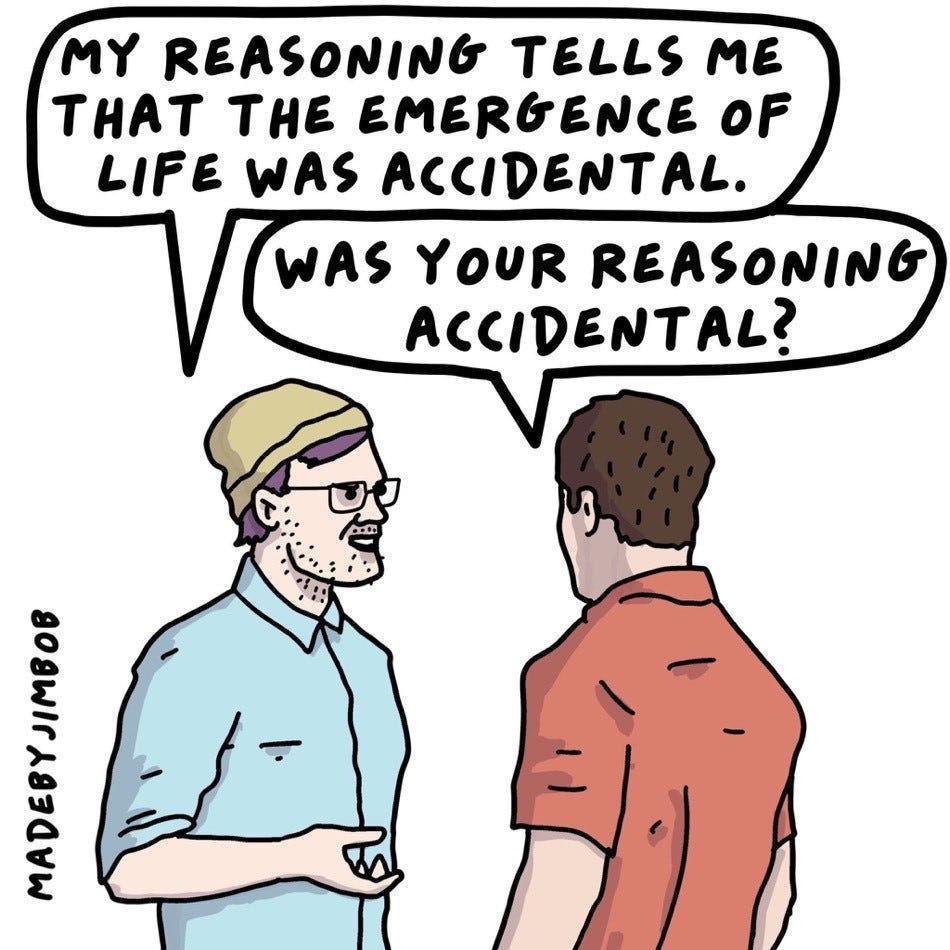
For the Enlightenment liberal, man’s intellect is the starting point, and man himself is the apex of life. Reason alone, not any specific tradition or shared culture, makes sense, bringing order to the universe. Empiricism, rationalism, nominalism, materialism, scientism, and biblical higher criticism are all on the table. So too for the constitutional conservative of today: as long as we conserve a few pieces of paper in the National Archives, individuals are free to conserve (or not conserve) whatever they want. Man is free to embrace radical nominalism (concepts have no integral connection to the object) and even to invent his own truth—provided he does not not deny the truth of the Constitution.
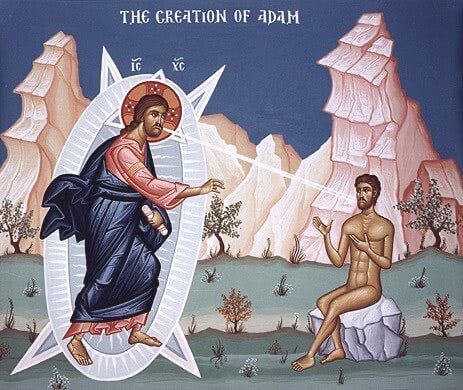
Contrast all this with Christianity. To the Christian mind, exemplified in medieval and Byzantine thought, the Triune God is the foundation of everything—his beliefs, actions, and traditions. God is the source of all knowledge and reality. We could know nothing if not for God’s Revelation in Jesus (The Logos, the Truth). Christ is the Divine Mind that brought the very concepts we use into the world at Creation. Truth is revealed, not constructed. Man is illumined by the Grace of the Holy Spirit in his heart. Man is not creating anything original; he can only transform what preexisted him, including the non-physical concepts he uses. The fact that Man is made in the Image of God gives him the ability to discover truths about the world he inhabits.1 Enlightenment liberalism is directly at war with this reality; but so too is American Conservatism, which simply increases the Liberal’s head count of immutable, received truths by one.
A major area of departure between Christianity and Liberalism are their respective theories of law and governance.
Christian traditionalism is based on positive liberty or “freedom to” act as one wills within the structural limitations of a society. Liberalism, by contrast, is based on negative liberty—“freedom from” interference, coercion, or the absence of obstacles. Enlightenment ideas gave birth to legal positivism (the idea that morality is contingent on whatever law is posited).
Parts of the US Constitution (Section 9) and the Bill of Rights are essentially a series of prohibitions against state actions on its citizens. In these, the state is in theory supposed to be constrained from what it can do. While the Declaration of Independence is not technically a legal document it does attempt to establish the identity of what an American is, poorly in my view. This is a major point of contention between the Founders, including the view that the American Revolution was not actually a revolution but an aristocratic succession.2 This is not to say there are no elements of positive liberty or law in the US Constitution. (Article II of the Constitution for instance, when interpreted broadly, gives the Chief Executive immense—one could argue monarchical—power.) It is to say, though, that there is an overabundance of negative liberty in our governing documents. This means that American conservatives of today, who functionally conserve only the Constitution, are de facto liberals.
The problems inherent in Liberalism are coming to a head now, but they have always been there. Liberalism is blind to the fact that not everyone will interpret what is written in the Constitution in the same way. How one interprets our founding documents is a direct function of population variables for which neither the Liberal nor his Conservative cousin can control.
Chief among these weaknesses is their functional deism. Nature’s God, for the Deist founders (and for their founding documents) need not act in the clockwork world, and thus has no political relevance. Claiming belief in a “higher power,” without identifying it in a pragmatically meaningful way, allows the liberal (free) individual to build his life around whichever God of Nature he happens to choose; and the God one chooses will directly affect how he understands something like the First or Second Amendment.
Another weakness is their functional neutrality on race and culture; mere religious membership doesn’t solve everything. Catholics, despite their denominational unity, are more split on abortion than the culturally homogeneous (if denominationally fractured) WASPs.
To be fair to the Founders, what they wrote and envisioned was for a specific people (ethnos) and in a specific time. The basic concepts they used such as citizen, liberty, and free man have totally different meanings today than they did then. They formed a government for the “citizen” of that time not what a “citizen” is today. The point is not to criticize the Founders (who were not a monolith anyway—see the correspondence between Jefferson, Adams and Hamilton), but to address the Liberal Conservatives today who think that allegiance to the documents they wrote, and the negative liberty contained in them, is a sufficient basis for having a nation.
Third and finally, negative liberty has no answer for a gradually morally degenerating population. To their credit, many of the Founders recognized this. John Adams wrote if America lost Christianity or its general moral compass it would collapse—due to the incredibly loose nature of its governing power, degeneracy would become rampant. Adams was very clear on this point—and, as many have noted, there is nothing in the Constitution forbidding states to erect state churches. I simply point out that 250 years later, there are no state churches here in any meaningful sense.
An actual conservative nation must conserve the racial, cultural, and religious deposit of its founding stock. Without that, there isn’t anything to conserve. The Romanov Dynasty of Tsarist Russia took as its main principle of governance from the second letter to the Thessalonians:
“And you know what is now restraining him, so that he may be revealed when his time comes. For the mystery of lawlessness is already at work, but only until the one who now restrains it is removed.”3
Until someone can act in a Christlike way there must be restraints against him. When he does, there is a traditionally based positive liberty available to him.
America today, however, is facing the unrelenting impetus to eliminate all traditional constraints by neglect. This is the logical conclusion of the Liberal Enlightenment worldview which Conservatives cherish— and neither the Constitution, the Bill of Rights, nor the political parties shot through with their logic, will do anything to stop it. The fallacy of the autonomous human mind solving all problems is everywhere—from the tech industry to self help gurus and “life coaches.” Its salvation is in apotheosis or deification via self-actualization. Christian salvation is union with God by the Grace of the Holy Spirit.4
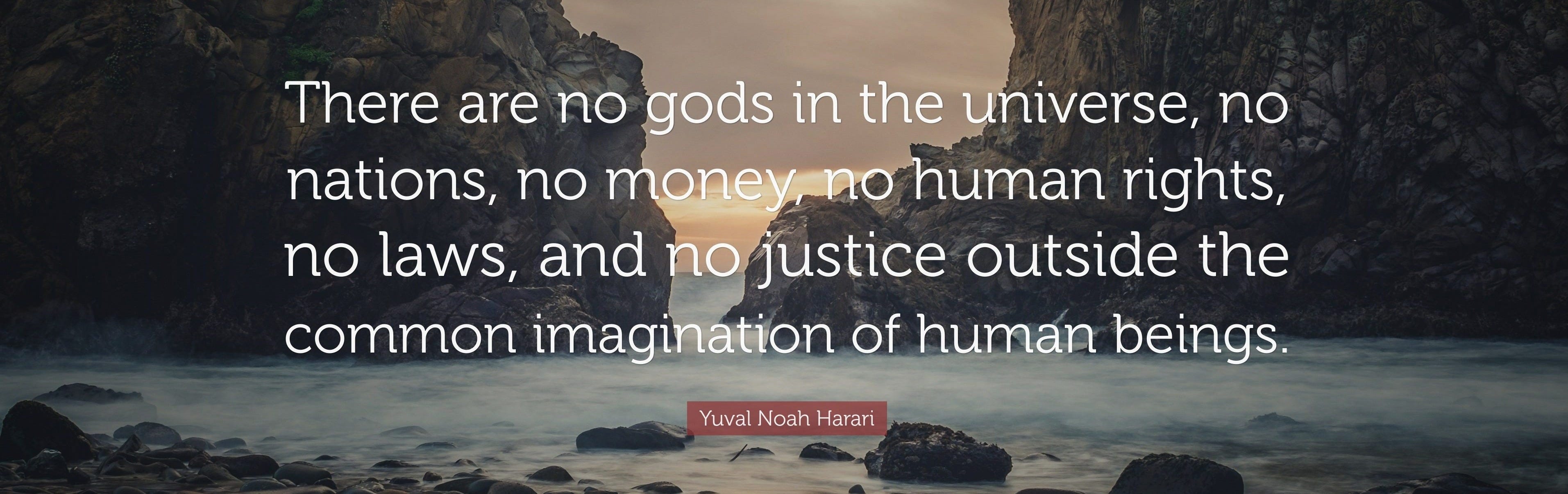
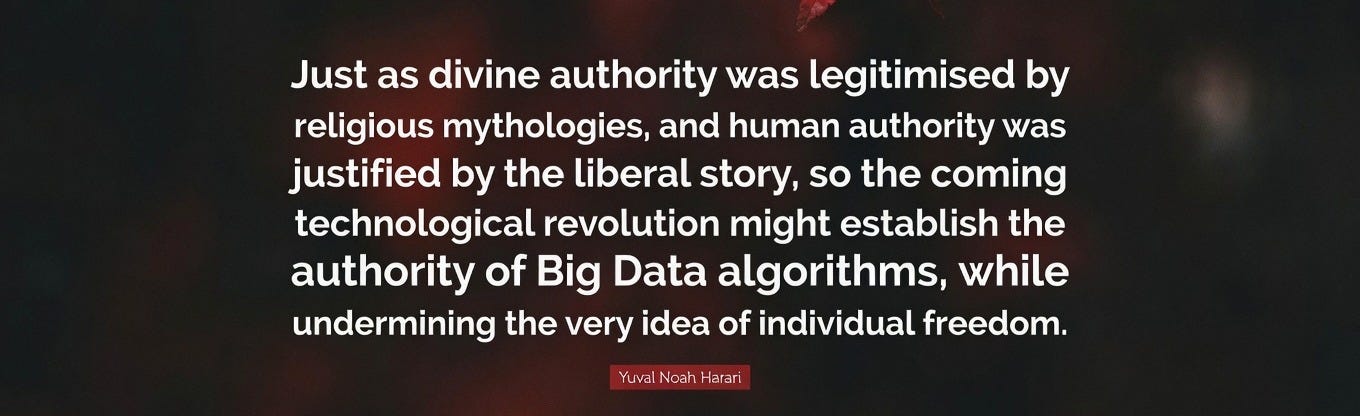
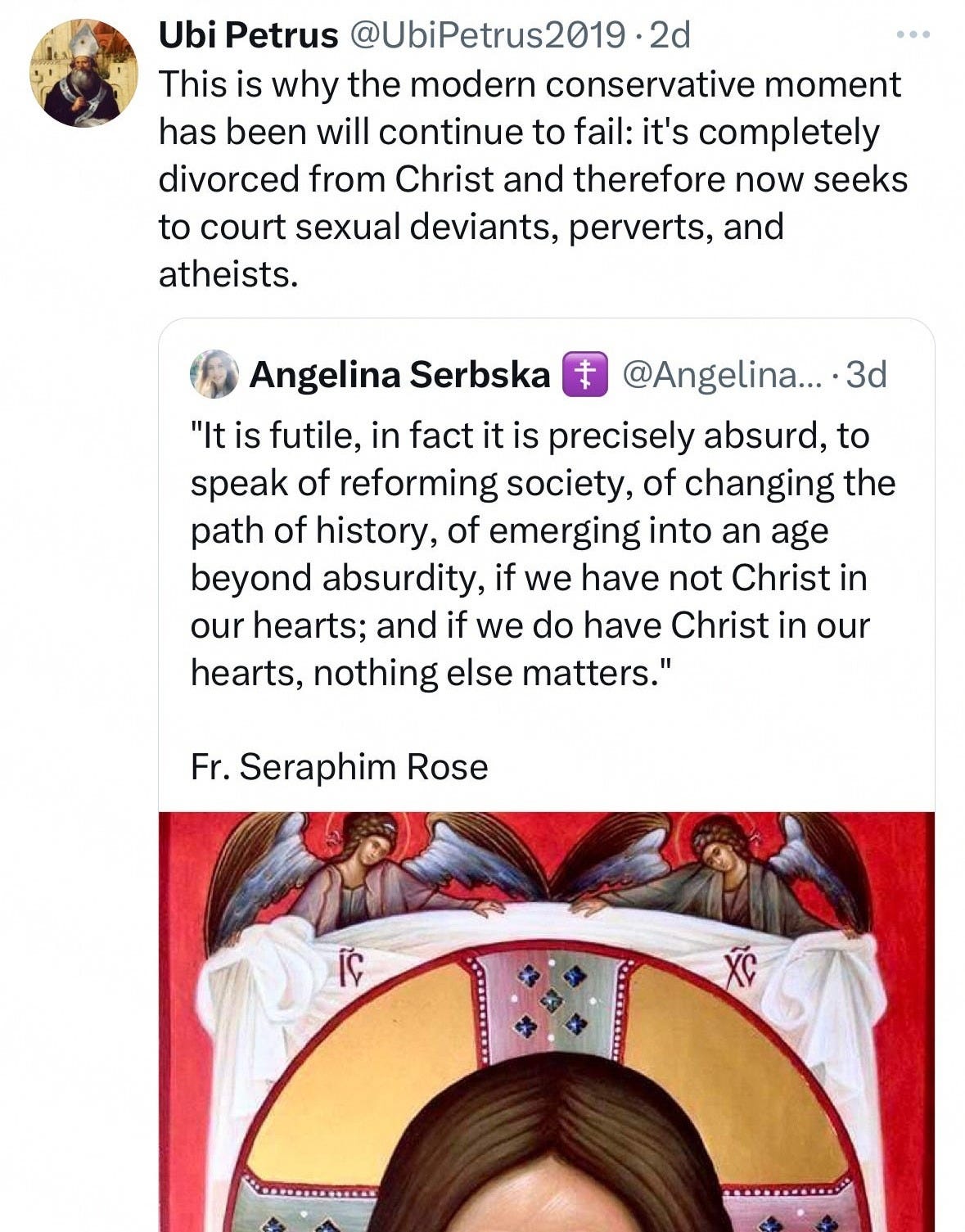
Today’s conservatism makes no distinction between union with God and the pipedream being sold via Elon Musk and other transhumanists: the deification of man without God. The transhumanist religion is being welcomed by tens of millions and even by so-called Christians and conservatives. Why care about religion when you could just become a robot and live forever? Does the conservative wish to preserve the values of Yuval Noah Harari, intellectual head of the World Economic Forum?
In the face of liberal-conservative logic controlling our political institutions, counterrevolution is pointless. Western populations are not ready and do not want this. Only pockets of human capital organization, spiritually independent of the regime but subject to God, can be the future and bulwark of the Right Wing movement. It will have no connection to American Conservatism because Conservatism, in the modern sense, retards any Right Wing organizing. The Conservative differs from the Liberal in precisely this respect: it masks itself as a friend of the Right. The Conservative is, therefore, the Right’s closest and most direct Enemy. Conservatism in the classical sense no longer exists; belonging to previous centuries, it will not return. While the future may seem bleak, harsh environments can cause major and rapid reactions, which can occur rapidly during a decline or collapse.
While we do not know what the future of our nation holds, if you are a Christian, you should know that Christ rules our people and cares for us. There is nothing to fear, for if we repent, we can become vessels to enact His purifying truth in the world.
“The sacrifice pleasing to God is a broken spirit; a broken and a contrite heart, O God, Thou wilt not despise.”
I enjoyed the piece, thank you for writing it. I wish you had dealt some with the Warren court and 20th Century distortions. The things the conservative claims to hold (Christianity, US Constitution, etc) seem sort of silly to argue against when "For ourselves and our posterity" is explicitly in the text, as are many verses of Scripture that would get you the fluoride stare when quoted. I don't so much intend to say 'real x hasnt been tried' as to say what the AmCon understands himself defending is generally a sign more than a thing signified.
I would also ask you don't include memes in these essays. It breaks up the flow considerably and I think your rhetoric more than adequately communicates the point without them.
The fact that you think Thomas Paine was a founder and that the founders were deists shows the actual problem, which is that leftists rewrote the historical narrative and inserted things which were untrue to serve their current political purposes, and all you actually have to do on the Right in America is recover, restore, and reshape that historical narrative using most of the actual history, which is far more on side than the current prevailing narrative is. Here’s an article explaining such







I enjoyed the piece, thank you for writing it. I wish you had dealt some with the Warren court and 20th Century distortions. The things the conservative claims to hold (Christianity, US Constitution, etc) seem sort of silly to argue against when "For ourselves and our posterity" is explicitly in the text, as are many verses of Scripture that would get you the fluoride stare when quoted. I don't so much intend to say 'real x hasnt been tried' as to say what the AmCon understands himself defending is generally a sign more than a thing signified.
I would also ask you don't include memes in these essays. It breaks up the flow considerably and I think your rhetoric more than adequately communicates the point without them.
I look forward to reading more from you.
The fact that you think Thomas Paine was a founder and that the founders were deists shows the actual problem, which is that leftists rewrote the historical narrative and inserted things which were untrue to serve their current political purposes, and all you actually have to do on the Right in America is recover, restore, and reshape that historical narrative using most of the actual history, which is far more on side than the current prevailing narrative is. Here’s an article explaining such
https://kaiserloengramm.substack.com/p/thomas-paine-and-the-rewriting-of